From December 3-06 till today July 25-09 ( 2 1/2 year) this post is viewed 50,000 times.
55,000 times viewed on October 28 2009 , 60,000 times viewed on February 17 2010
70.000 times viewed on August 8 2010, 80.000 times viewed on March 22 2011
© 2006 -2011

This work is licensed under a Creative Commons Attribution-Noncommercial-No Derivative Works 3.0 Unported License.
I prefer to sew the zipper after the seam underneath the zipper opening is closed. I use a longer zipper for example the zipper opening is 12 inch my zipper is at least 13 inch. A too long zipper can be cut of with a pinking shear from the bottom after the zipper is sewn. If your garment will be lined a couple of stitches over the coil will do to stop the zipper from separating .For an unlined garment it is a neat way to finish the end of the tape by covering it with a piece of lining or a satin tape.
The opening is stabilized with fusible interfacing .
I find it easy to have a mark on my fabric where the zipper needs to be stitched ,that’s why I start sewing the zipper opening with a large stitch and a loose tension. sew the seam beneath the zipper opening as usual.
Press the seam open and remove the stitches of the zipper opening seam. The pressed seam for the opening has now a fold which acts as a guideline.
I sew on a Pfaff with snap on feet and do not use the plastic invisible zipper foot which has to be screw on. I use the normal zipper foot,

Press the seam open and remove the stitches of the zipper opening seam. The pressed seam for the opening has now a fold which acts as a guideline.
I sew on a Pfaff with snap on feet and do not use the plastic invisible zipper foot which has to be screw on. I use the normal Pfaff zipper foot.
I need to press the zipper coil flat so I can sew with my usual zipper foot.My pressing iron has a Teflon foot so the coil won’t melt.
Here you can see the difference of the flat pressed coil at the right with the not yet pressed coil at the left.


The zipper coil is placed over the pressed fold, you can pin the zipper in first to check if you are on the right spot.

If you want to be sure you can baste the zipper tape (in this example the left side because that is the one which will be sewn first)
Using a non perfectly match color thread in the spool will be handy if you need to rip the stitching in case it went bad. Think black thread on a black zipper you can use dark grey or dark blue which is easier to see if you need the seam ripper.
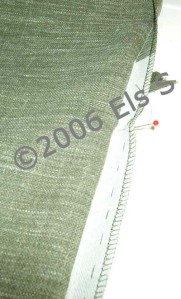 I start sewing the zipper from the top down ( I sew the left side of the tape first) with a few back stitches and the last stitch is at the end of the opening I don’t back stitch here but I sew backwards.
 The next step is sewing the zipper from the top down ( I sew the left side of the tape first) with a few back stitches and the last stitch is at the end of the opening I don’t back stitch here but I sew backwards in a diagonal line for about 1 inch towards the outer edge of the zipper tape.

Close the zipper and pin / baste stitch the other side of the zipper at the fold line sewing from the bottom towards the top. Do not back stitch at the beginning this can be done later when you have checked if the zipper is sewed perfect without bumps.

Close the zipper the full length again to check if the zipper is sewed perfect
Because the zipper is longer than sewed the pull is now at the loos end of the zipper .
The last inch gentle pulling the zipper pull from the inside.

A few back stitches by hand with the upper thread pulled down .

Zipper is sewn, view from inside.


outside view
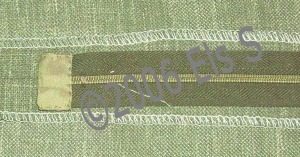
For a neat finish, I cover the end of the cut of zipper with a piece of lining.
14 Comments:
- Gorgeous Things said…
- Els, what a great tutorial, thank you! I have always sewn my invisible zippers on before closing up the seam, and I always have a fight with my garment to avoid any bubbles at the zipper bottom. This method looks like it will eliminate that problem. Thank you!
- 11:50 AM
- Lorna said…
- Thanks, els! I have also sewn these in before sewing the seams. I don’t use the invisible zipper foot either as it does not fit my machine. I usually just use the machine zipper foot as I cannot adjust the needle position on my machine. Do you switch the needle over when sewing in the zips?
- 1:37 PM
- Abi said…
- Thank you very much for the visual tutorial.Almost exactly what I do except I use the Viking invisible zipper foot and leave a 5cm gap unsewn.I then try to fudge a bubble free end.All I need is to use a longer zipper.
Excellent. - 2:09 PM
- Anonymous said…
- Els, thank you very much. I hate fighting that little bubble at the end of the invisible zipper. I’m going to have to give this a try. It looks like a very sleek method.Jodi
- 2:29 PM
- said…
- Thanks. I use invisible zippers a lot but have never produced one that I really liked. You have several tips here that I will try!
hjm - 2:52 PM
- Mary Beth said…
- Great tutorial, Els. Thanks!
- 4:51 PM
- Gigi said…
- That’s great, Els! I’ve always inserted mine into an open seam but I’m excited to try your method.
- 4:51 PM
- Anonymous said…
- Thanks for this. I’m going to print and follow on my next invisible.
Betty Fleet - 4:59 PM
- Phyllis said…
- T%his is great! Very thorough and easy to understand. I’ve been wanting to improve my invisible zipper sewing for a while now.
- 6:30 PM
- Lisette said…
- Very good timing! I have a bunch of stuff that needs Invisible zips and the ones I’ve done I haven’t liked much. Thanks so much for this!
- 6:21 AM
- Cindy said…
- Els, Thank you! Great tutorial! I cannot wait to try this method on my next invisible zipper.
- 8:03 AM
- Anonymous said…
- Somehow these pics remind me of another example in one of Threads Magazine’s tutorial. The colors you chose are very difficult to show details just as that of the Threads tutorial. Invisible zippers are easy and fun once you know how but can be daunting for a beginner. I personally prefer to use the special invisible zipper foot but I have also used the same foot/machine brand like you did successfully. I would finally like to add that Pfaff did make an invisible zipper foot (metal) which has the same part number as the one you used, however it cannot be used with the IDT.
Signed: Aging Eyes - 9:24 AM
- Anonymous said…
- Els,This is a great tutorial! I wish more people knew how to put in an invisible zipper. It looks so much more professional! In fact, I only ever use a fly front or invisible zipper application, so I can’t wait to try your method. I, like others use the open seam method.
- 3:44 PM
- Anonymous said…
- Thanks Els for this tutorial! Always try to finesse that little bubble at the bottom with tiny handstitch. But I’ll try your method – that diagonal stitching on bottom intrigues me. I’ll be off to the machine to try this. Thanks again! UTZ
- 3:12 AM

 Subscribe with Bloglines


 THE SEWING DIVAS sewing, design, fashion
Thanks for the great tutorial…been years since i have done an invisible zipper…was doing a very formal and elegant dress for my daughter out of silk duchess satin..needed an invisible zipper…perfect the first time!!!!!! THANKS
Comment by joan — January 5, 2007 @ 10:40 pm
Thank you so much for this tutorial. I used it recently, it was my first time putting in any sort of zipper and I think it was a success. Thanks again!
Comment by loopylulu — April 3, 2007 @ 7:27 pm
I had to take in a dress for my son’s wedding as I’d lost weight since I bought it about 4 weeks previously. The invisible zipper was in the side seam and I was worried about how it would turn out. Thought I’d look on the internet for some advice and found your tutorial. It came out right the first time and looks great. Thank you so much.
Comment by Marilyn — May 10, 2007 @ 7:46 pm
Very nice tutorial. Thanks for sharing.
Comment by Marty — July 2, 2007 @ 10:26 pm
I stumbled on this website by accident while looking for a place to purchase hair canvas fusible interfacing. I enjoyed the blog on invisible zippers. I also have problems sewing invisible zippers expecially towards the bottom since I cannot sew pass the zipper pull with a regula r zipper foot, the invisible foot or the regular sewing foot. I have a Singer QuantumXL 100. Enjoy this page very much. Thanks.
Comment by Anna — October 16, 2007 @ 1:34 pm
[…] where I am – this is the interior back of the dress with the finished invisible zipper, installed with Els’ method of course. The edges of the zipper tape and the seams are finished with rayon seam binding machine stitched […]
Pingback by Holiday 2007 - Interior Work « The Sewing Divas — December 2, 2007 @ 10:52 pm
A colleague showed me how to do this once and it was really an “a-ha” moment as I’ve obviously seen it in a lot of RTW. So, so much easier!
Comment by dawn — December 4, 2007 @ 7:54 am
I’m glad to see it can be done with the regular zipper foot. I tried for twenty minutes to finagle the plastic invisible zipper foot and gave up! Great tutorial!
Comment by Jennifer — January 31, 2008 @ 1:44 am
I just used your method to put in an invisible zipper and I can’t thank you enough. No bubble at the bottom, no ripping out. Perfect the first time I did it. How could it be any better or easier?
Comment by Nancy — February 1, 2008 @ 3:46 pm
Thanks Els for the great information. I am working on my daughter’s wedding with 5 bridesmaids dresses all needing 2 invisible zippers each. I can’t wait to try your technique on my Pfaff 2144.
Comment by Janice Leffel — April 1, 2008 @ 1:39 pm
You’re welcome.
Comment by Els — April 1, 2008 @ 4:41 pm
I tried and tried and somehow just can’t get this down. It might be because English is not my first language or because the pictures are all jumbled up and don’t correspond with the captions =(. I got the first side OK, but then I just can’t figure out how to continue. I just can’t so get the bottom to look right. I always have a little bubble at the bottom and the only way I could make it look decent is by sewing the seam line under the zipper by hand. Still is not perfect, but acceptable. I would like to learn to do it you do it. Could you please fix the picture layout or maybe take some more picture with a solid fabric and contrasting thread so I can see it better? Thank you.
Comment by Natalija — May 28, 2008 @ 4:04 am
Natalija, Like all new sewing techniques it takes some practise to get it done correctly.
I did sent you an email, hope this will help you to sew the zipper in without any problems.
Comment by Els — May 28, 2008 @ 4:52 pm
[…] goodness for Els’ Invisible Zipper tutorial! It has helped me immensely. Every time the panic sets in now, I just open that link, take a deep […]
Pingback by Thanks to Els’ Invisible Zipper Tutorial « The Sewing Divas — June 5, 2008 @ 7:55 pm
I wish I had seen this before; I sent my wedding dress out to have the zipper put in and I almost think I could have done it myself with this and a few practice zippers.
Comment by cheesepirate — July 12, 2008 @ 2:03 am
Got these invisible zipper instructions via patternreview knowledge base. These instructions were just what I was looking for. Thank you so much.
Comment by Cathy — August 9, 2008 @ 6:08 am
Thank you for a wonderful tutorial. This really helped with my first invisible zipper in the seam on a Vogue top that I was making. The zipper turned out perfect. Wish that was occurring with the top.
Comment by Darla in PA — September 14, 2008 @ 8:23 pm
Hello, very nice tutorial, where i can find invisible zippers. thanks
Comment by FX — September 16, 2008 @ 3:55 pm
These are great instructions and I can’t wait to give them a try on a bridesmaids dress I am making for my daughter. I have a question though…
The dress has two layers, one sating and a chiffon overlay. I am worried about the two layers being sewn together at the zipper and then having to be seamed separately below the zipper. Is there anywhere I can see a tutorial on this or do you have any suggestions?
Thanks! You can email me at sandra_continuity@shaw.ca if you wouldn’t mind.
Comment by Sandra — November 4, 2008 @ 11:35 am
[…] I like this one: Sewing Invisible Zipper. […]
Pingback by The First Communion Dress Project - part 4 « Simply Catholic — March 9, 2009 @ 2:41 pm
This article was written was the wand of a lot of my help. Thank you very much, I’ll study a lot.
Comment by startrekdvd — April 6, 2009 @ 11:15 pm
Great tute which I will try today.
Comment by Bunny — April 16, 2009 @ 6:20 am
Thanks so much for this info! I have never used an invisible zipper and the package made it look so difficult. Your instructions and photos were so clear that I did it on the first try and it looks great. Thanks for helping get my dd’s Communion dress done.
Comment by Eileen — May 1, 2009 @ 2:44 am
[…] skirt has an invisible zipper at the CB and a contoured front waistband and a straight waistband at the back side due to her […]
Pingback by Flared hem skirt « THE SEWING DIVAS sewing, design, fashion — May 9, 2009 @ 8:02 am
Ive always been intimidated by invisible zippers and have never attempted to try one. This has really limited the type of garment I can make or alter. After this tutorial I put in my first invisible zipper (with a regular zipper foot)and it turned out perfectly. Thanks so much.
Comment by jkochman — May 14, 2009 @ 10:25 am
You are fabmagical!!! Coffee at my place!!!! Any type any place!!!!! Thank you!!
Comment by felicia — December 10, 2009 @ 3:45 pm
Thanks sooo much for sharing this info. Sewing people are just the best. Love the clear and simple explanations! Once again, thanks.
Comment by robbie — December 24, 2009 @ 1:39 am
Thanks for this tutorial. I have never been able to get an invisible zipper truly invisible before. There is always a thin line of tape showing on the front. This is problematic when the bodice is a contrastinc color or has a contrasting color yoke or detail. I have hated using invisible zippers because of this. I have even tried sewing them in by hand only to have the slide get stuck on the stitches and refuse to close. And of course there is always that bubble problem at the bottom. I am anxious to get to my studio and try this method. If it works, I will be tearing out an invisible zipper i just put in my granddaughter’s prom dress and redoing it.
Comment by Linda Lee Schell — April 2, 2010 @ 4:52 am
Great tip – thanks for the info, I’ll give it a go with my singer7470
Comment by CheckThisProductOut — May 26, 2010 @ 10:36 am
Very nicely illustrated. How come I didnt even know this tips after two years working in the fashion industry? what a shame, will definitely put this on my note for next time! Thanks.
Comment by Kolia — May 27, 2010 @ 4:35 pm
Thanks for the great tutorial.. Keep up the brilliant work!
Comment by jef brown — July 11, 2010 @ 10:29 pm
[…] kind of gal, which is kind of liberating to realize. But back to THIS invisible zip. I used this tutorial and it worked out smashingly. I’m so thrilled to have an actually invisible invisible zipper […]
Pingback by In the nick of time « ~E Made This! — July 12, 2010 @ 8:13 am
This is the tutorial I always refer to when sewing invisible zippers, it works like a charm for me and it’s one of your best “pearls of wisdom”
Comment by Tany — August 16, 2010 @ 5:46 am
Nice useful article keep post like this.. Thanks for sharing this info.
Comment by AdhiSesha — August 25, 2010 @ 2:05 pm
I have been having trouble with zippers bumping up and down like a roller coaster whenever the dress is put on. What could be causing this to happen. whenever I put the zipper in, it looks fine, and straight.
Comment by Linda — October 2, 2010 @ 1:37 pm
I’ve learned both methods of inserting an i-zip and I prefer this one.
Comment by Sewer — October 10, 2010 @ 3:50 pm
[…] as the face (I have an aversion to shiny fabrics of late). I inserted an invisible zipper using Els’ Amazing Method. I basted the lining and the outer dress together at the neckline, then attached them to the corset […]
Pingback by Pattern Review – Vogue 2237 Badgley Mischka Gala Dress | Gorgeous Things' Blog — November 13, 2010 @ 8:54 am
Thanks for this! I tried an invisible zipper once and after many arguments, got it in ok, but it was complicated and confusing. These instructions will go along way to bringing my blood pressure down.
Comment by Liz Doerry — November 13, 2010 @ 4:01 pm